هلالtonight’s moonشمسةthe sixteen-petal rosette — how it is drawn

The observatory

Tonight’s moonهلال

Next new moon
—
Next full moon
—

The first thin crescent — هلال, the hilal — is the moon a day or two out of conjunction, and it is a beginning. The Hijri calendar is lunar: twelve months of twenty-nine or thirty days, a year some eleven days shorter than the solar one, so its months walk backwards through the seasons. A month opens when the new crescent is seen — and the naked-eye hilal is a hard object, thin and low and lost in the dusk it hangs in, which is why what counts as seeing it has been argued over for centuries.

That is one reason the astronomers of the medieval Islamic world measured the moon as closely as they did. Al-Battani, who spent most of his life at Raqqa and died in 929, left the earliest surviving zīj — a book of astronomical tables — in the Ptolemaic tradition, and tables like it could place the crescent before anyone went out to look for it. The disc above is worked the same way: everything on it follows from ψ, the angle between sun and moon, which fixes both the phase and the lit fraction, (1 − cos ψ) ⁄ 2.

The observatory

The sixteen-petal rosetteشمسة

the compass circle · sixteen points

Everything here is stepped off one circle. Sixteen points around it, each joined to the sixth from it; the {16/6} star polygon that follows then supplies its own measurements — the petal valleys at 0.689 R where consecutive chords meet, the ring at 0.390 R where they cross closest to the centre. Nothing is chosen by eye.

Patterns built on that kind of scaffolding are girih, the interlaced strapwork behind much of Islamic geometric ornament; cut from glazed terracotta and set piece by hand-chiselled piece, the same figures become zellij, the mosaic of Morocco and al-Andalus this page is named for. What craftsmen carried between sites was the construction rather than the finished design: the Topkapı Scroll, 114 patterns from the Timurid workshops, is the one pattern-book of its kind to survive. The eight-pointed star this rosette closes on is the khatam — two squares laid across each other, the octagram the Qur’an uses in its margins as the Rub el Hizb.

Ahmed El Gabri

أحمد الجابري

Two-centred drop arch — the Mosque of Ibn Tulun, Cairo, 876–879

Blog

Custom colors in your ZSH prompt

I have been using ZSH as my main shell for nearly a year & I really love it! Most of my days are between iterm2 & Sublime Text 2. So customizing both are a natural thing for me.

So I have already customized my terminal to a very good extend but lately I have been more into trying to do some shell scripts to fasten my workflow. Like pushing, Committing, minifying and/or compiling my Sass code. I wanted to output some colored messages in the terminal but I didn’t like my limited color pallet in the terminal (Red, Green, Yellow, Cyan, White, Black, etc..) I wanted different color hues & some fancy stuff.

So I searched for this if it’s possible & I found this for ZSH & iterm2, another search for “Spectrum” & I found this function Actually, it turned out that the spectrum function is already in ohmyzsh . Drop this function inside your .zshrc file then call spectrum_ls in the terminal & boom! watch the magic.
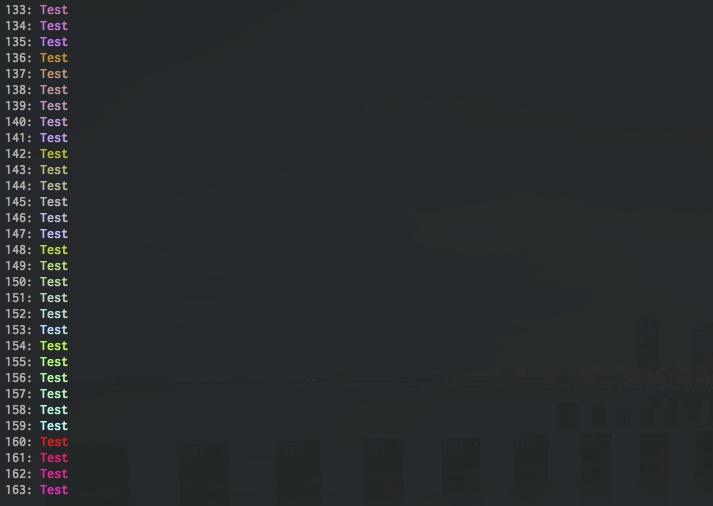
zsh-colors

Now all you need to is to reference the color code outputted like so $FG[000] in your ZSH theme, just replace “000” with the color code “000” is black btw & you are good to go! for example in create a new ZSH theme & try this PROMPT='$FG[154]%~%{$reset_color%} '.

I hope someone can find this useful, I didn’t know about it before & I’m really in love with the terminal.

You can share this post or reach me on @ahmedelgabri.